
The Invisible Hearing Aid Fad: BUSTED!

A Toast to Technology, Transparency, and Turning Up the Volume on Life
The only time you should be embarrassed by your hearing aids is if they’re not working!
Let’s cut through the static, shall we? There’s a whisper in the hearing aid industry—a glossy, airbrushed promise that your hearing solution should be so discreet it practically vanishes. “Invisible!” they proclaim. “No one will ever know!” Sounds lovely, doesn’t it? Like a secret superpower. But here at Audiology Northwest, where Dr. Jonell Block has been restoring the joy of hearing since 2004, we’re here to say: Hearing aids aren’t invisible—and they shouldn’t be.
Now, before you clutch your pearls (or your tiny, flesh-colored domes), hear us out. This isn’t a manifesto against miniaturization. We’re not suggesting we revert to the trumpet-sized ear horns of yore. But this obsession with invisibility? It’s doing you a disservice. It’s time to reframe the conversation.
The Mirage of Invisibility: Why “Hiding” Misses the Point
The marketing can be so seductive, painting the perfect dinner party attended by perfect-looking folks having the time of their lives, all while smugly rejoicing that their hearing aids have been rendered so microscopic they’d make a flea feel inadequate. The message is clear: Your hearing loss is something to be concealed. Your technology should be a secret shame, tucked away like an embarrassing tattoo.
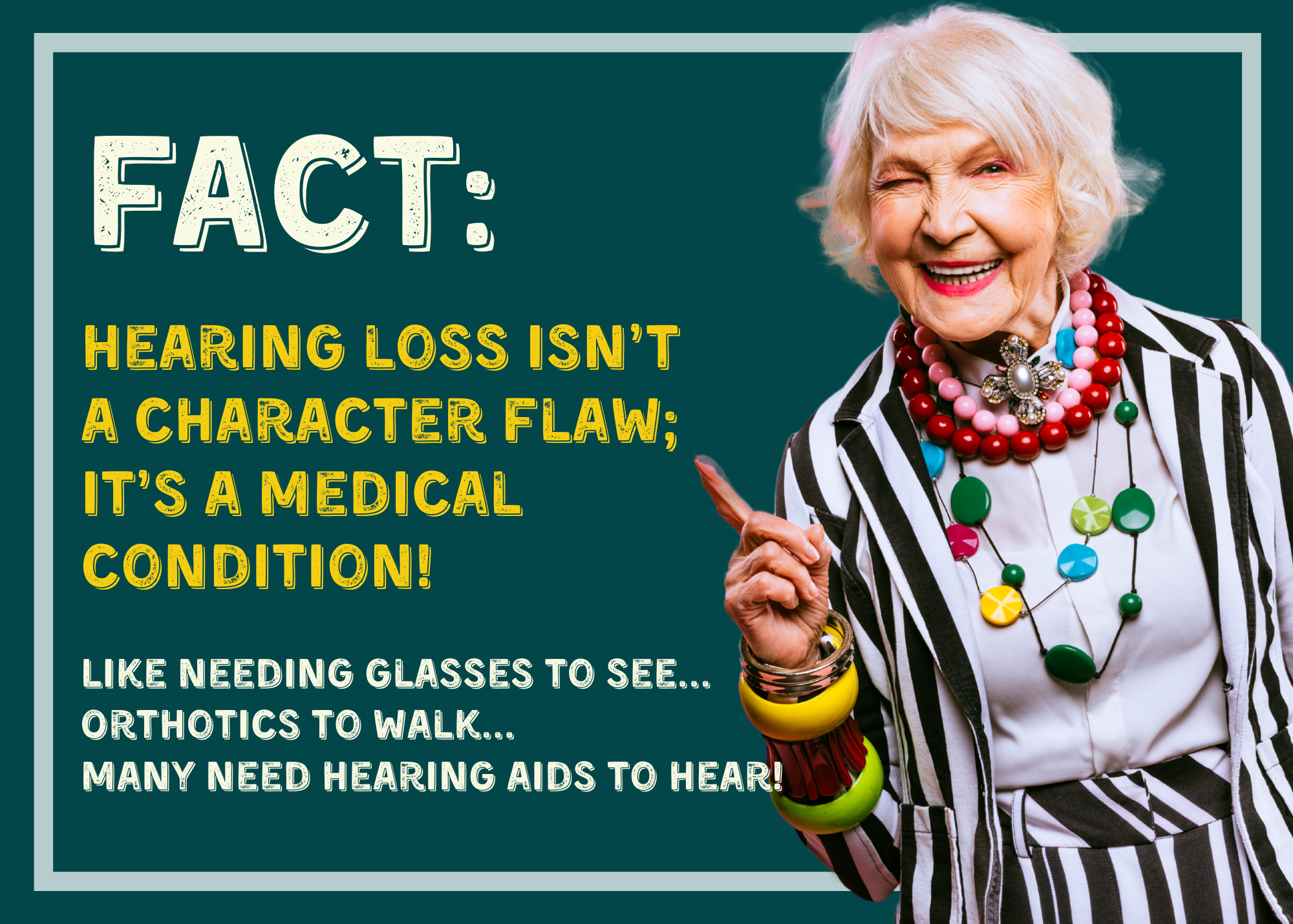
FACT:
Hearing loss isn’t a character flaw; it’s a medical condition, and it’s as natural as needing glasses to read a menu or a knee brace to hike a trail. Do we demand that bifocals be indistinguishable to the naked eye? Do we insist that orthotics be invisible inside our shoes? No! We celebrate the technology that helps us live better, fuller lives. So why the double standard for our ears?
The more ‘invisible’ a hearing aid, the less it performs. To shrink a device down to the size of a lentil, manufacturers have to make compromises on really big features, such as:
Robust noise reduction that makes a crowded restaurant tolerable.
Bluetooth connectivity that streams your favorite podcast, phone calls with loved ones, and even your television directly to your ears.
Battery life that lets you go from sunrise to sunset without a frantic search for a power outlet.
Is any of that a worthy trade? We think not… not unless your hearing loss is so minimal that you don’t need these helpful features!
This isn't just our opinion. The research consistently points to a significant problem with hearing aid adoption that has nothing to do with the technology's effectiveness and everything to do with perception. A landmark study published in “Ear and Hearing” by Kochkin (2007) found that the primary barriers to hearing aid adoption were not related to cost or performance, but to stigma and perceived negative self-image. The study, titled "MarketTrak VII: Obstacles to adult non-user adoption of hearing aids," revealed that "negative personal image of hearing aid user" was cited as a key reason for not seeking help. The marketing of "invisibility" directly feeds this stigma, reinforcing the idea that hearing loss is something to be hidden rather than addressed. (1)
The Beauty in Being You: Your Hearing Aids are a Badge of Honor
Imagine, instead of hiding your hearing aids, you showcased them. Picture having a device so sleek, so stylish, so ‘you’ that it becomes a conversation starter at that delightful diner party, with people who you actually like and like you. “Oh, those? They’re my hearing aids. They’re also my Bluetooth headphones, my translation device, and my secret weapon against noisy grandkids.”

That’s the future we’re championing. A future where hearing aids are worn like a smartwatch—a piece of cutting-edge tech you’re proud to display. A future where the color options go beyond “flesh tone” and include bold blacks, vibrant blues, and metallic silvers to fit your personality and style—a future where design is as intentional and beloved as the technology.
Why? Because when you stop treating hearing aids like a dirty little secret, you change the narrative. You empower others. You normalize a condition that affects millions of people. You say, “I’m taking charge of my health, and I’m not afraid to show it.” That’s not weakness. That’s strength. That’s style.
This shift in perspective isn't just about feel-good psychology; it has tangible benefits for treatment outcomes. Research in the “International Journal of Audiology” by Wallhagen (2010) explored the profound impact of stigma on the psychosocial well-being of individuals with hearing loss. The study, "The stigma of hearing loss," highlights that stigma can lead to social withdrawal, depression, and a decreased quality of life. Conversely, embracing the technology and refusing to be shamed can counteract these effects. When a hearing aid is seen not as a symbol of decline but as a tool for engagement, it becomes an instrument of empowerment rather than a marker of a deficit. (2)
Dr. Jonell’s Take: Function, Not Fashion, Gives You the Joy of Hearing
Dr. Jonell Block has seen it all in her years serving the Greater Spokane Area. She understands the anxiety, the hesitation, the fear of being “that person with the hearing aids.” However, she also knows the life-changing transformation that comes from prioritizing function.
“When we work with our patients,” Dr. Jonell says, “we’re not just fitting a device. We’re crafting a solution. That means finding the perfect balance of comfort, performance, and confidence. If a patient feels self-conscious about a bulky, whistling aid, they won’t wear it. But if they’re sold on the myth of invisibility and end up with a device that can’t keep up with their lifestyle, they won’t wear it either.”
That’s why Audiology NW takes a holistic approach. We’ll always find the perfect hearing device for you, taking into account your needs, wants, and budget. We partner with top-tier manufacturers like Starkey, Unitron, Signia, and Phonak—companies that innovate not just in size, but in substance. We offer in-home visits because your comfort is our priority. We provide counseling and training because your success is our mission.
Our goal isn’t to sell you an illusion. It’s about seeing you reclaim your life, and yes, sometimes that means a hearing aid that’s entirely visible, powerful, and unapologetically awesome.
Hard data backs this focus on function and successful use. A comprehensive review by Laplante-Lévesque, Hickson, and Worrall in “Ear and Hearing” (2013) examined the factors that drive hearing-aid use. Their findings, published in "A qualitative study of the influences on hearing aid use and non-use," emphasized that positive outcomes and consistent use were strongly linked to factors such as "self-acknowledgment of hearing difficulties" and "positive experiences with the hearing aid." When a device delivers real-world benefits—in noisy restaurants, on phone calls, with family—its visibility becomes a non-issue. The technology's success speaks louder than any cosmetic concern. (3)
The Bottom Line: Don’t Buy the Hype, Buy the RIGHT Solution for You.
So, the next time you see an ad promising a hearing aid so small it gets lost in your ear canal, ask yourself: What am I really paying for? Am I investing in better hearing, or am I trying to look perfect for that dinner party that you’ll never go to because you can’t hear what’s being said?

Hearing aids aren’t invisible—and they shouldn’t be. They’re a testament to human ingenuity. They’re a tool for connection. They’re a celebration of sound, from the chirp of a morning bird to the laughter of a loved one. They’re your personal, wearable reminder that life’s worth living… and it’s worth hearing.
It’s time to stop hiding and start living! Schedule a consultation with Dr. Jonell today and take the first step toward embracing a world where your hearing aids are as visible and vibrant as the life they help you enjoy… it really is life-changing!
---
At Audiology Northwest, we’re not just in the business of selling hearing aids. We’re in the business of restoring joy. And that’s something we’ll never keep under wraps!
RESOURCES:
Kochkin, S. (2007). MarketTrak VII: Obstacles to adult non-user adoption of hearing aids. *Ear and Hearing, 28*(4), 535-542. The PCAST Report and How it Could Harm Patients — Part 3 | Hearing Health & Technology Matters. https://hearinghealthmatters.org/hear-in-private-practice/2016/pcast-harm-otc-hearing-aid-patients-part-3/
Wallhagen, M. I. (2010). The stigma of hearing loss. *The Gerontologist, 50*(1), 66-75. (Note: This was published in The Gerontologist, a highly relevant journal in the field, and widely cited in audiology literature). https://pubmed.ncbi.nlm.nih.gov/19592638/
Laplante-Lévesque, A., Hickson, L., & Worrall, L. (2013). A qualitative study of the influences on hearing aid use and non-use. *Ear and Hearing, 34*(6), 667-679. https://www.researchgate.net/publication/225292426_A_Qualitative_Study_of_Shared_Decision_Making_in_Rehabilitative_Audiology